Marketing Analysis Case Study, TU, Malaysia At its founding in 1906, Planters Peanut Company sold one nut type. Historically, peanuts were viewed as food
At its founding in 1906, Planters Peanut Company sold one nut type. Historically, peanuts were viewed as food for the poor, produced and consumed locally. Southeastern states (Georgia, Virginia, Florida, Alabama, and Mississippi) were the predominant growing states. Peanuts were not technically a nut, but rather a legume. They were a rotational ground crop, meaning the land on which they grew changed plantings from one growing season to the next. Peanuts returned nutrients to the soil to benefit subsequent plantings of other crops.
From its early days, Planters had aspirations to become “the national nut,” offering the consumer “high-quality peanuts from Planters at low costs anywhere.”3 Mr. Peanut was born in 1916 and was outfitted with a top hat, monocle, and cane to emphasize high quality, even though “working for
peanuts” was a common phrase. Early advertising proclaimed “Planters is the word for Peanuts.” The nutritional benefits of peanuts were also noted; for example, a 1936 ad read, “They give you 2½ hours extra pep daily.” In the 1940s, the program to elevate the status of peanuts continued as Planters
introduced Planters Cocktail Peanuts, positioning them as “wonderful for parties.” The Planters brand became well known through advertising, and more than 200 stand-alone Planters Peanut stores were established around the US.
Planters innovated in peanuts with the introduction of dry roasted peanuts (1962) and expanded the product line to include cashews (not grown in the U.S. but imported), mixed nuts (1985), and trail mix (1998). In 2000, the health benefits of nuts were featured in advertising, as in the headline, “Did you know nuts help lower cholesterol?” In 2005, peanuts still clearly dominated the snack nut scene, as 50% of U.S. households bought some brand of peanuts during the year. Cashews trailed at 33% penetration, and pistachios and almonds held “specialty” status with just over 10% household penetration each. Much would change over the next seven years.
Stuck in Completing this Assignment and feeling stressed ?
Take advantage of our private writing services and get help from professionals.
Snack Nut Category Evolution
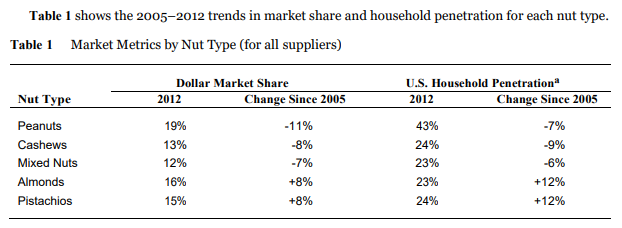
Almonds and pistachios were not rotational crops, but rather tree nuts. An almond tree might take five years to mature to full production and then produce continually for 25 years or more on an annual growing cycle. A pistachio tree was a “biennial bearer,” meaning a heavy crop one year and a light one the next. A pistachio tree’s bearing life was indefinite. As such, the supply of tree nuts was relatively fixed for the near term. In 2012, 6,500 almond growers in California produced almost all of the US output and 80% of the world’s output.
U.S. pistachios were a relative “latecomer” to nut production, being first commercialized in the United States in 1976, with growers concentrated in California, Arizona, and New Mexico. California growers dominated, with 98% of U.S. output and 24% of the world’s output.5 Paramount Farms, in California’s San Joaquin Valley, was the world’s largest grower of pistachios, accounting for 60% of California’s output.

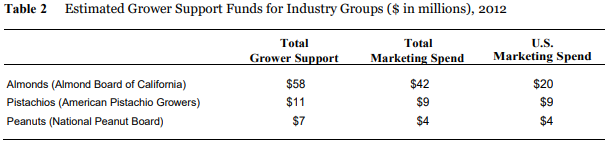
Almond growers formed the Blue Diamond Cooperative in 1910 to coordinate research and development on growing techniques. This later led to the selling of almonds under the Blue Diamond brand name and the formation of the Almond Board of California to help with demand stimulation efforts. The board was funded by the growers. Similarly, pistachio growers jointly funded the
American Pistachio Growers group to coordinate market development for pistachios. Table 2 shows total grower support for three nut types and the amount of that support directed to demand development in the United States.
Since almonds had a large export market, about half of the Almond Board of California’s spending was outside the United States. The growers and funders were typically represented on the boards of these organizations and approved spending plans.
Are You Searching Answer of this Question?
Request Malaysian writers to write a plagiarism-free copy tailored to your question.
Get Help By Expert
Looking for cheap assignment assistance? Get top-notch marketing analysis case study solutions at pocket-friendly prices. Assignment Helper My offers expert assistance for Taylor’s University (TU) students. Our experienced writers provide unique and well-researched content tailored to your requirements. With our affordable services, you can excel in your assignments without breaking the bank.
Need the complete answer?

Need a custom solution for this question?
Share your module details and get fast, original academic support from our team.