
NATS 1870 Understanding Colour Assignment 1: Comparative Mixing Directions
| University | York University (YU) |
| Subject | NATS 1870 Understanding Colour |
NATS 1870 – Assignment 1: Comparative Mixing DIRECTIONS
Due: Feb 23, 11:59pm (online)
Worth: 20%
LATE ASSIGNMENTS NOT ACCEPTED
Goals:
- Perform various types of mixing processes, using various media, and compare your results from different exercises
- Describe your results for each exercise
- Answer questions about the exercises and demonstrate your understanding of the material
Format:
- Each mixing investigation consists of a practical section (e.g. mixing paints) and a written section (answering questions about the investigation).
- Use the TEMPLATE file to complete your project as follows:
- Take images of any work produced in the practical sections, and insert into TEMPLATE file as directed.
- Type your answers for the written questions.
- Save your file as a pdf (make sure file size is within stated limits), using filename: Lastname_Firstname_1870_A1.
- Upload pdf to link on eclass.
- Note – docx and pdf versions of the TEMPLATE file are available on eclass. If you wish to use anther program/ editor to create a similar file, that is fine, as long as you save it as a pdf. Notes, pages files are not readable by eclass.)
Notes:
- You are expected to complete the exercises and write-ups on your own. Note that copying from another student, using the same painting swatches, or otherwise duplicating results is considered plagiarism and is punishable.
- If you think you might have limited colour vision (mild or otherwise) – please speak with professor and/or make a note on your assignment. An adapted version of this assignment is available.
- You will need your 3D colour model (Week 1 homework) to complete some of the questions.
Materials:
- Acrylic Paints: Red, Yellow, Green, Blue, Black, White. Optional: Magenta & Cyan o Sources: Michaels, Staples, Aboveground Art store, Dollar store, Amazon also fine
○ **Only a small amount of paint is needed; don’t get oil paints
○ Inexpensive options: Michaels has inexpensive sets: Set 1 Set 2 ; Staples has a Crayola set with magenta
o Note the brand and specific colours used in your assignment
o You may share paints with a friend, but you must do your own exercises, and
hand in your own work (otherwise it will be considered plagiarism)
o Other colourants (pencil crayons, crayons etc.) may also be possible to use if cost is an issue. Speak with the professor. - Heavy paper (printer paper would be too light) – e.g. from Michael’s: Example 1 Example 2 (small) o Paint your ‘swatches’ (areas of colour) on the heavy paper, cut them out, then tape or glue them a larger page.
- Palette for mixing paints – can use foil or plastic plate (white) Paintbrush
References:
- https://colourliteracy.org/comparative–mixing–explained
- Good site on mixing processes: http://www.animations.physics.unsw.edu.au/jw/light/colour–htm
- David Briggs’s hue value chroma site – excellent information on all types of colour mixing – e.g.
http://www.huevaluechroma.com/051.php for subtractive mixing and http://www.huevaluechroma.com/045.php for sample spectral reflectance curves
1870 A1 Comp Mixing TEMPLATE.pdf
Instructions:
PART 1. Subtractive Mixing Process: Paints
In PART 1, you will mix paints to create a hue circle and complements, and sketch the reflectance curve for each component colour, as well as the mixed colour. You will then answer questions based on the subtractive mixing process.
For the assignment, mix coloured swatches and arrange them as indicated in the instructions. Take an image and insert into the TEMPLATE file.
Q1.1 Mixing intermediate hues and arranging in a hue circle:
Choose 3 traditional ‘primary’ hues – i.e. RYB or CMY (either is fine). Create a 12-step hue circle, mixing equal visual steps (as best as you can) between the hues. On the same sheet of paper, sketch reflectance curves for each hue. (Note: marks will be deducted if you do not follow directions.)
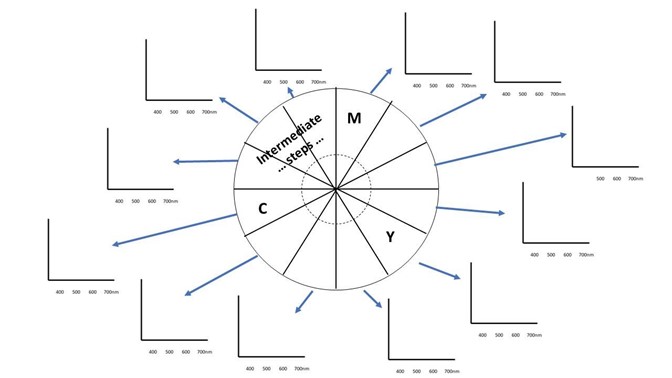
You will answer questions based on this exercise in TEMPLATE file.
Q1.2 Mixing Subtractive complements
One way to define complementary colours is: two colours, which when mixed subtractively, produce (achromatic) grey).
Choose 2 opposite hues from each other on your hue circle (e.g. M and G). Mix them to a colour closest to grey that you can, and sketch a reflectance curve. Describe the hue, lightness and chroma of your mixed colour.
Lay out your work as follows, and insert image into TEMPLATE file.
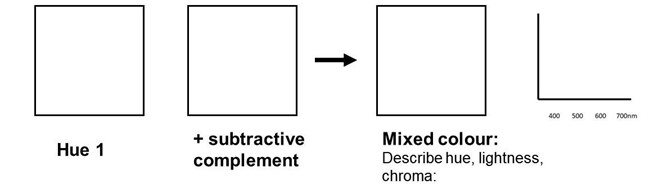
Using your 3D colour model (from Week 1’s homework), identify which grey or near neutral matches your mixed grey best, and take an image of the two swatches, and insert into TEMPLATE file.
PART 2. Optical Mixing Process: Spinning Disks (Temporal Mixing)
In PART 2 you will explore a type of additive mixing called temporal optical mixing, which results due to the persistence of vision. You will perform your investigation using spinning disks, and compare the temporal optical mixtures with the subtractive mixtures.
Experimental Procedure:
Using the template below, create a spinning disk for optical mixture as follows:
Starting with yellow and blue paints, mix the two paints together subtractively (on your palette) and then paint the central circle of the disk with that colour. On the outer pie-shaped areas on the circle, paint alternating areas of each hue separately. An example is shown below. When the paint is dry, cut out your disk and spin it rapidly. What is the optically mixed colour? How does it compare to the subtractively mixed colour? You will investigate other colour combinations, and document your investigation in a table.
Example: (**More templates at end of file)
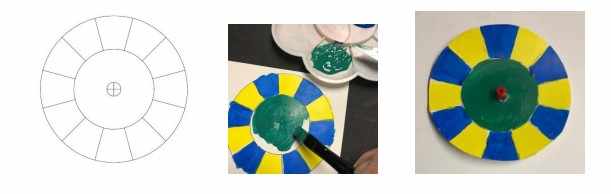 Method: The method of quickly spinning the disk is up to you (some options: use a fan from the dollar store, a CD player, see link on eClass for using a string, may be able to find disks at dollar store or Amazon, drill, put a screw in the lid of a jar). You need to have a way to spin the disk fast enough to see a single blended colour – if you do not see a single colour, try another spin method (likely disk is not spinning fast enough). Describe the mechanism used to spin the disk.
You will also explore creating optical complements in this section which are defined as 2 colours which when mixed optically, produce (achromatic) grey.
Do the exercise, using combinations of:
- blue and yellow;
- red and green;
- red, blue and green;
- black and white;
- use the same hue and subtractive complement as 2
- find the best combination of colours to give an achromatic grey for the optically mixed colour (not using black and white!)
Note – this is a very cool effect. You are free to explore as much as you like – try other media like pencil crayons, coloured paper; or prepare the coloured outer portions of the disk on the computer and make a coloured print out. You can vary the proportions, or vary the layout on the disk. Be creative!
Record your exercise results in your Observing Log shown below. Include a comment on how the subtractive mix differs from the optical mix. You will answer questions based on this exercise in TEMPLATE file.
Observations
| Image of disk
|
Discussion on how optically mixed colour compares to subtractively mixed colour. Be as precise as you can, and include hue, lightness and chroma of mixture (or if they are achromatic) in your answer. You can use your 3D model to help you identify and describe the optically mixed colours. |
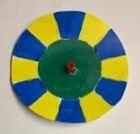
Blue, Yellow |
EXAMPLE: Optical mix is a pale, lime-green. Subtractive mix is dark green.
Optical mix is lighter and has lower chroma than subtractive mix. Describe what you see for your mixtures. |
| Blue, Yellow
|
** Do your blue and your yellow |
| Red, Green | |
| Red, Blue, Green | |
| Black, white | |
| Subtractive complements | |
| Best optical mix for grey | ** Not using black & white paints |
PART 3. Additive Mixing Process: Lights on a Computer Screen
In this section you will be mixing colours additively using a simple interactive on your computer screen or phone, and comparing your mixed colours to subtractive and temporal mixes.
(Note – if the interactive does not work on your computer or phone (a Java script) – see if another student can help. Or if you can find a similar app/program, you can use that instead.)
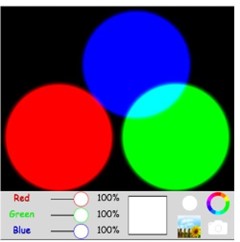
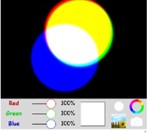
To additively mix the coloured light sources, drag the circles to overlap each other. The intensity (or amount of light emitted) from each circle can be adjusted using the sliders at the bottom). An example is shown for mixing blue and yellow light sources, shown a) at full intensity, and b) at 53% intensity.
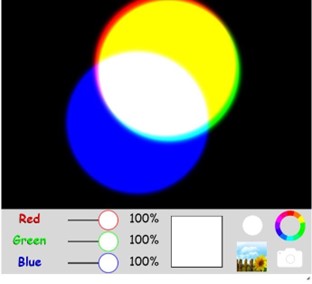
a) mixing blue and yellow light sources at full intensity
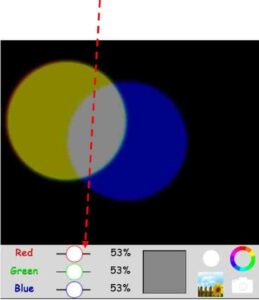
b) mixing blue and yellow light sources at 53% intensity
Complete the following table:
| Coloured light sources for additive mix | a) Additively mixed colours at full
(100%) intensity Insert screenshot and describe the mix fully with its hue, lightness and chroma, or if it is achromatic |
b) Additively mixed colours at approximately 50% intensity.
Insert screenshot and describe the mix fully with its hue, lightness and chroma, or if it is achromatic |
| Blue, yellow | White/achromatic
|
Middle grey/achromatic |
| Red, green | ||
| Red, blue | ||
| Magenta, green | ||
| Red, green, blue | ||
| Subtractive complements
from Q1.2 |
You will answer questions based on this exercise.
Part 4: Afterimage
Choose your subtractive complementary colours from Q1.2, and paint one in the left circle in the template below, and the other in the right circle.
Generate the afterimage of the colour on the left, by staring at dot in the middle the painted circle on the left for 30 seconds, then looking at the dot in the white circle in the middle. How does the colour of the afterimage compare to the colour in the right circle (i.e. the subtractive complement). Describe any differences in terms of hue, lightness and chroma, as well as the perceived luminosity of the afterimage.
You can try to match the hue, lightness and chroma for the afterimage colour, and paint a swatch beside the subtractive complement. If the afterimage and subtractive complements are different, why do you think they are different? You could also try the exercise in reverse, starting with the other hue, or try other pairs of hues.
The final question for the assignment will ask you to compare the subtractively mixed grey using the complements of Q1.2, with the optical mix, the mix on the computer screen, and the afterimage colour.
Any plagiarized work will be dealt with according to the York University Senate Policy on Academic Honesty. Penalties can include a grade of zero for the entire assignment. Make sure you are familiar with this policy.
http://secretariat–policies.info.yorku.ca/policies/academic–honesty–senatepolicy–on/
Get Help By Expert
NATS 1870 assignments require students to combine practical colour mixing experiments with clear visual documentation and accurate conceptual explanations. Many students struggle with comparing subtractive, optical, and additive mixing, presenting results correctly, and writing precise reflections under strict submission rules. If you need Art & Design Assignment Help that supports both practical work explanation and academic writing, Assignment Helper provides reliable assistance. All work is 100% human-written, AI-free, and plagiarism-free, aligned with university academic integrity standards. With homework assignment help, students can confidently manage studio-based and theory-based assignments together.

Recent Solved Questions
- Decision Making Skills Assignment, UUM, Malaysia What are two (2) problems you have encountered and two (2) benefits you have gained while working in a group
- Unit 3 – Strategic Management And Leadership, Assignment, Malaysia
- ASSIGNMENT INDUSTRIAL PROJECT FOR PROF DIPLOMA
- MPCF7113 – Final Assessment, CU, Malaysia – Corporate Finance, Case Study
- CHE471: Chemical process principles I Assignment, UiTM, Malaysia The rate of heat loss from a tank to the surrounding by convection and conduction is expressed
- Property Management System Assignment, APU, Malaysia Identify a business domain for Condominium Property Management. Construct a software solution using
- MMP706: Project Management Assignment, AeU, Malaysia You are the project manager for your company’s MCP project. You are collaborating with your project team and business
- OUMH1603: Learning Skills for 21st Century Assignment, OUM, Malaysia Demonstrate Critical Thinking and Creative Thinking. Use your critical thinking and reasoning skills to solve the following problem
- MPU3323 TAMADUN ISLAM DAN TAMADUN ASIA 1 Assignment, OUM, Malaysia Tugasan ini adalah untuk menilai kebolehan pelajar membincangkan sumbangan dan hasil pencapaian tamadun
- Please explain the impact of interest rates on residents’ savings and investments: Macroeconomics Assignment, WMC, Malaysia